What does surveillance look like?
Here are several types of surveillance that I encountered in Madison. You can find an in-depth guide to these, and other, forms of surveillance from the Electronic Frontier Foundation.
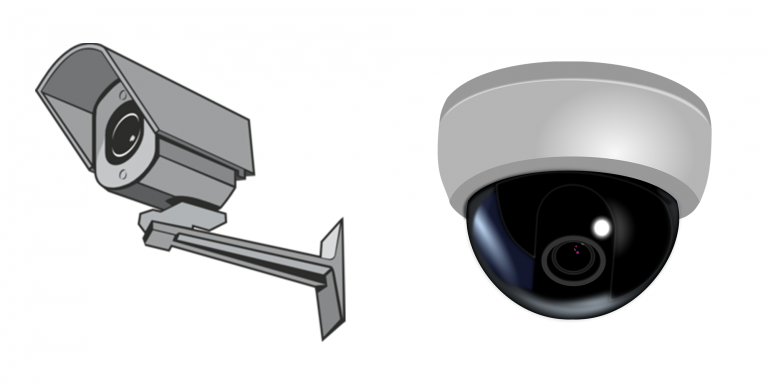
- Pan-tilt zoom (PTZ) cameras surveil a 360 degree area and live broadcast video to police or security. PTZ cameras come in many models, below are two types that I saw.
- As its name suggests, fixed automated license plate reader (ALPR) collects the license plate numbers of passing vehicles, which are uploaded to a database with their date, time, and location. Mobile ALPR performs the same function but is attached to a police vehicle.

Surveillance, surveyed
I was surprised by the amount of surveillance I observed in downtown Madison, which wasprimarily PTZ cameras and fixed ALPR. Sometimes these types of surveillance looked very similar so I relied context to differentiate them. Fixed ALPR tended to be attached to streetlights at busy intersections. I only noted one example of mobile ALPR, which looked like a small black box attached to the roof of a police car. PTZ cameras were usually above the entrances of establishments and, when inside, on or near the ceiling. Cameras accompanied by screen monitors seemed to be placed strategically to remind shoppers and patrons that they are being surveilled and to deter crime. Such monitors at the entrance, exit, and pharmacy of a grocery store I went into sent a clear message—to me at least—that everything I did was being recorded. In the past, I have also observed this camera/monitor combination in gas stations and drug sores.
How did I do it?
I conducted this investigation in two parts. First, I completed “Spot the Surveillance” virtual reality training through the Electronic Frontier Foundation. This training outlined six types common types of surveillance, what they do, and where to find them. Second, I walked from campus down Main Street and went to Stop & Shop, passing the Madison Police Department and Madison Train Station on the way back. Most of my observations on surveillance came from this exploration of Madison.
Conclusion
This investigation forced me to consider the importance and limitations of my own privacy in the context of surveillance. How do I feel about being surveilled in some capacity every time I am in a public space? Does the general public benefit from this type of surveillance? If not, who does?
My observations also made me consider the limitations and affordances of “real life” and digital surveillance. “Real life” surveillance seems to be more transparent because it is more easily observed, recorded, and quantified. However, efforts to limit or subvert surveillance—thus gaining some control over our privacy—are often illegal, such as not having a license plate or obscuring its number to prevent surveillance from ALPR. Interestingly enough there are digital elements of “real life” surveillance; video can be broadcasted or data uploaded to online databases. My greatest takeaway was that surveillance—both “real life” and digital—is complex and nuanced but our dialogues about it often are not. I believe that we need to develop a greater awareness of our privacy, its threats, and methods of surveillance. Future research and scholarship will be important and will inform everyday discussions about privacy and surveillance as they continue to rapidly evolve (see this article about surveillance and tattoos). Perhaps most importantly, it is crucial that we, as individuals, educate ourselves so we can critically examine and discuss issues of privacy and surveillance.